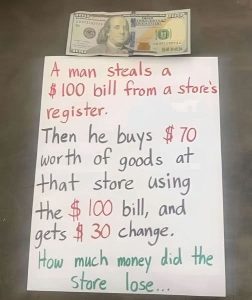
In the digital age, where content spreads like wildfire, it’s no surprise that a simple math brain teaser has taken the internet by storm. The $100 puzzle, which challenges users to figure out how much money a store lost when a thief stole a $100 bill and then made a purchase, has racked up millions of views and sparked intense debate among puzzle enthusiasts.
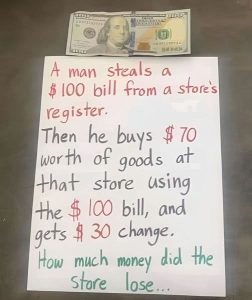
The brain teaser, which was shared on X (formerly Twitter) by an account called Out of Context Human Race, presents a seemingly straightforward scenario. A man steals a $100 bill from a store’s register, then uses that same bill to buy $70 worth of goods, receiving $30 in change. The question then asks, “How much money did the store lose?”
As the brain teaser gained traction online, a multitude of responses flooded the comments section. Some individuals confidently stated that the store lost $100, while others argued that the net loss was actually $130, taking into account the stolen $100 and the $30 in change. A few even suggested that the store’s overall loss depended on the profit margins of the individual transactions.
The key to solving this brain teaser lies in understanding the nuances of the scenario. While it may seem intuitive to simply state that the store lost $100 due to the theft, the reality is more complex. When the thief used the stolen $100 bill to make a purchase, the store effectively regained that $100. However, the store then had to provide $30 in change, resulting in a net loss of $30 in cash.
Additionally, the store also lost the $70 worth of goods that the thief acquired. Therefore, the total loss for the store was the $30 in cash plus the $70 in merchandise, equaling a total loss of $100.
The $100 brain teaser serves as a fascinating example of how a seemingly straightforward problem can become a subject of intense debate and analysis. It highlights the importance of carefully considering all the details and nuances of a given scenario, rather than relying on immediate intuitions.
Moreover, this puzzle underscores the power of the internet in amplifying and spreading viral content. The widespread attention it has garnered demonstrates the public’s insatiable appetite for engaging, thought-provoking challenges that stimulate critical thinking and ignite discussions.
The $100 brain teaser is a testament to the human fascination with problem-solving and the satisfaction that comes with unraveling complex conundrums. As we navigate the ever-evolving digital landscape, it’s crucial to maintain a curious and analytical mindset, always striving to see beyond the surface and uncover the deeper truths that lie beneath.
So, the next time a perplexing brain teaser captures your attention, embrace the challenge, engage your critical thinking skills, and revel in the thrill of cracking the code. Who knows, you might just be the one to solve the next viral puzzle that captivates the internet.